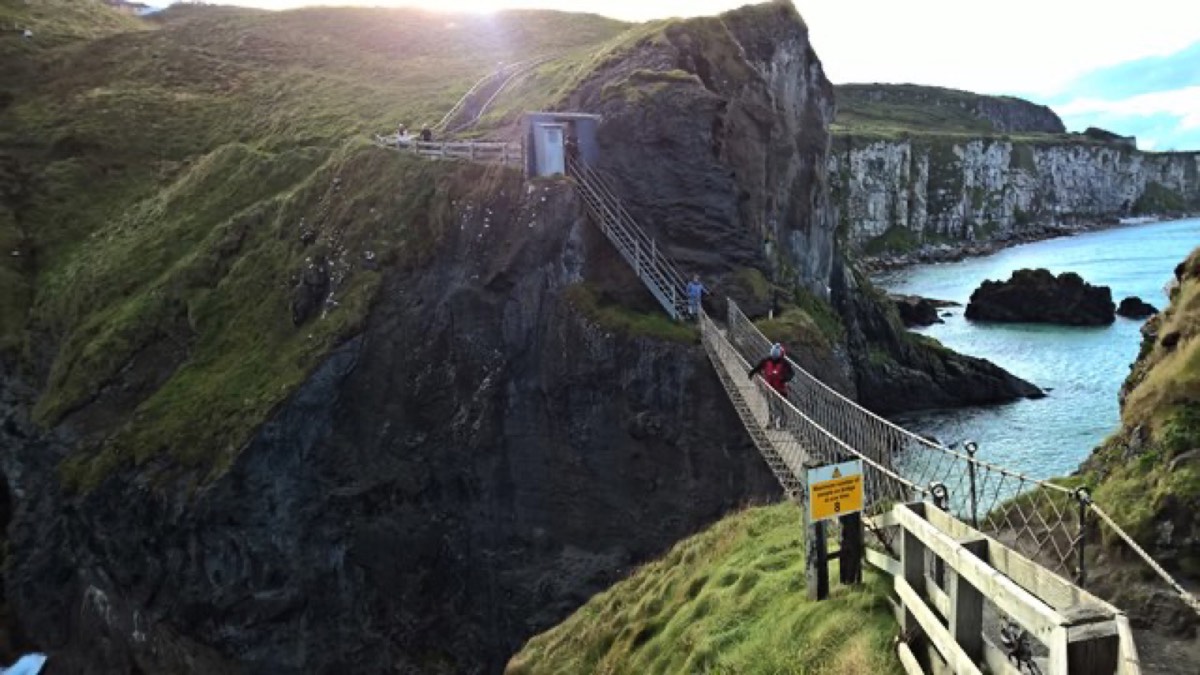
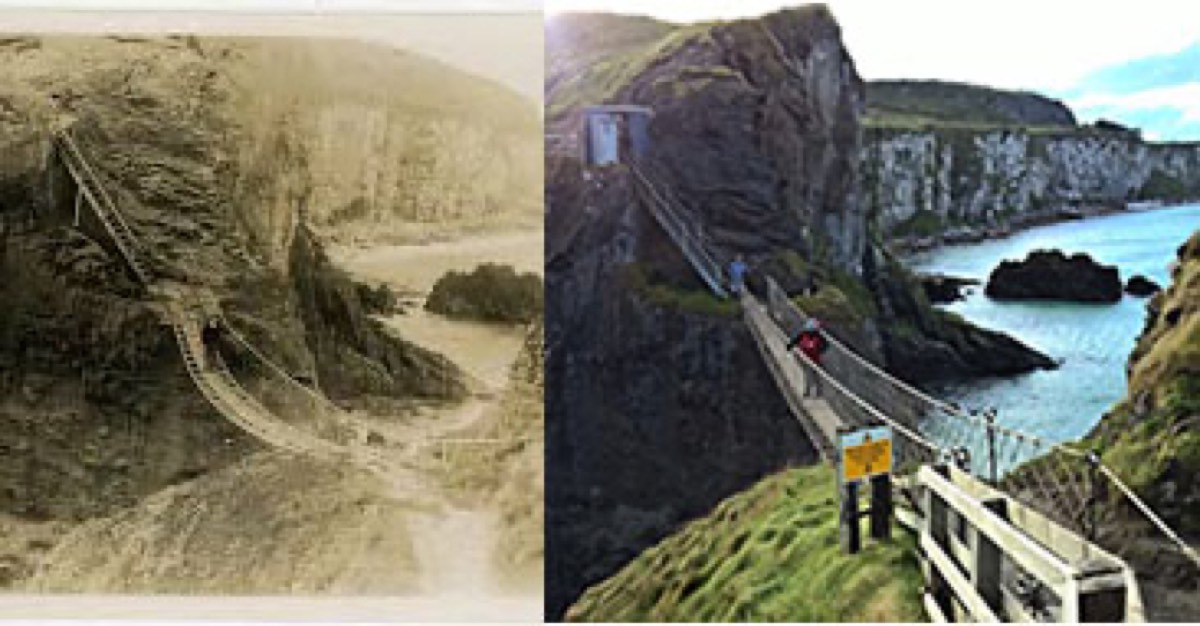
Carrick-a-Rede — from the Irish Carraig a’ Ráid, “rock of the casting” — is a rope bridge strung nearly 100ft above the Atlantic, linking the mainland to a small island once used by salmon fishermen. There’s been some form of bridge here for over 350 years, originally simple rope and wooden slats rebuilt each fishing season.
History
Salmon fishing here ran from June to September; the last commercial season was 2002, by which point catches had dropped to around 300 fish a year — a single day’s average catch in the 1960s. The current bridge, owned by the National Trust, was built by Heyn Construction in 2008 for £16,000: steel wire ropes and Douglas fir slats, 66ft long, rated for 10 tonnes (visitor numbers on the bridge are capped at 8 at a time by wardens, well within that).
What to expect
The path to the bridge is uneven gravel with steps at the end — not suitable if you have mobility issues, though the first 500m of coastal path is accessible and has a telescope viewpoint. The crossing itself takes a few minutes. From the island you can see Rathlin Island and, on a clear day, Scotland. There’s a car park and a tea room on-site.
The bridge closes in bad weather — check the National Trust’s Carrick-a-Rede social channels or website before travelling if conditions look rough.
Cost
Walking the coastal path and viewing the bridge is free. Crossing onto the island needs a timed ticket (the site gets over 450,000 visitors a year, so tickets are used to manage flow):
| Ticket | Online (advance) | Walk-up |
|---|---|---|
| Adult | £15.00 | £16.00 |
| Child (5–17) | £7.50 | £8.00 |
| Family (2 adults + up to 3 children) | £37.50 | £40.00 |
| Family (1 adult + up to 3 children) | £22.50 | £24.00 |
Free (but still need to book): National Trust members and under-5s. Check National Trust’s current pricing before you go.
Geology
The island is one of the best examples of a volcanic plug in Northern Ireland — the eroded neck of a volcano that punched through chalk beds around 60 million years ago. The harder dolerite rock at the front has eroded more slowly than the softer material behind it, which is how the island got its shape. Look for the sea caves at low tide, and keep an eye out for razorbills nesting on the cliffs.
On screen
Carrick-a-Rede doubled for Storm’s End in Game of Thrones’ second season — several key scenes in the Stormlands storyline (Catelyn Stark’s arrival at Renly Baratheon’s camp, Stannis Baratheon’s visit) were filmed here, including at the neighbouring Larrybane Quarry.
Booking a guided tour
Guided tours from Belfast typically combine Carrick-a-Rede with the Giant’s Causeway and the wider Game of Thrones filming sites along this stretch of coast.
Check availability on Viator →
Getting there
By car: about 15 miles / 20–25 minutes from Portrush along the A2, passing the Giant’s Causeway, the Dark Hedges, and Dunluce Castle. From Belfast, around 1hr 10, via the M2, A26 to Cloughmills, then onward via the A44. By bus: 402(a) or 172 (the “Causeway Rambler”) from Dunluce Avenue, Portrush. From Belfast, Goldline 218 to Coleraine, then the 402 or 172. From Dublin: about 3.5 hours by car, or a range of day tours.
The bridge opens at 9:30am; last ticket sales are 45 minutes before closing (as late as 7pm in summer, as early as 3pm in winter depending on weather and demand).